Choosing between annual and monthly ecommerce platform billing is less about finding a universally cheaper option and more about matching commitment to your store’s current needs. For a UK business, the useful comparison is usually cash flow, how likely the platform setup is to change, the features included at each plan level, and the payment or transaction costs that still apply.
Official plan pages should be your starting point. Squarespace says annual payment can save up to 36%, while Shopify’s UK pricing page presents yearly billing alongside plan tiers, card rates and team-capacity differences. Those examples also show why billing frequency is only one part of the decision: what the plan enables may matter more than the cadence itself.[^squarespace][^shopify]
Annual vs monthly ecommerce plans: the decision in brief
AI-generated generic editorial illustration — not a retailer product photo and does not depict the reviewed product or service. Illustration supporting this section.
 Annual billing can suit a store with a settled operating model: the team knows which selling features it needs, expects to stay on the platform, and can accommodate the upfront commitment. Monthly billing can be more useful when the store is testing demand, changing its sales channels, or still deciding what level of functionality is necessary.
Before comparing a yearly offer with twelve monthly payments, check four things:
- the plan’s included commerce, checkout, reporting and team features;
- payment-card and transaction charges that may apply separately;
- the cash required upfront and the length of the commitment; and
- the work involved if you later need to change plan or platform.
This keeps the question practical. A discount may be valuable, but it does not make an unsuitable plan suitable. Squarespace’s feature table, for example, differentiates transaction fees and commerce capabilities by tier. Shopify similarly distinguishes its UK plans by card rates, staff-account allowances and features such as regional selling tools.[^squarespace][^shopify]
Editorial comparison asset: annual and monthly billing calendars beside a neutral ecommerce storefront.
For a broader shortlist, see our ecommerce platform selection guide.
Where annual plans can help
An annual plan can make planning simpler when your store’s requirements are predictable. If the platform, plan tier and core sales process are already working for the business, paying once may reduce the number of subscription decisions the team needs to revisit during the year.
It can also give a clearer baseline for budgeting platform subscription spend. That does not remove variable costs, but it can make the recurring software element easier to forecast. Squarespace explicitly advertises annual-payment savings of up to 36%, so a stable store can compare that stated annual benefit with the value of keeping more cash available month to month.[^squarespace]
Annual evaluation is strongest when it is tied to an operating plan rather than a promotion. Consider whether the chosen tier supports the capabilities you already use and the ones you expect to need: product selling, subscriptions, invoices, staff access, regional selling, checkout requirements or shipping workflows. The official plan information for Squarespace and Shopify shows that these capabilities can differ by tier, as can some payment-related rates or transaction fees.[^squarespace][^shopify]
For a business that has already reached that level of clarity, an annual term can be a reasonable administrative choice. Review the features to compare in an online store platform and your ecommerce growth plan before treating a yearly term as a commitment to make.
Where annual plans can create friction
The main trade-off is commitment. Paying annually means committing cash and reducing the opportunities to reassess the subscription on a monthly cycle. That can be uncomfortable for a new store, a seasonal business, or a team that expects a major replatforming, redesign or channel change.
A yearly plan can also hide a mismatch if the decision is based only on the headline saving. A plan might include more capacity than the business currently needs, while a lower tier or a different platform could better fit its workflows. Conversely, a lower-priced tier may not include the capabilities needed for a growing team. Official feature tables are therefore more useful than a single price comparison.[^squarespace][^shopify]
Do not assume annual billing changes every commercial cost. Squarespace lists online-store and digital-content transaction fees by plan tier, while Shopify’s UK page lists card rates by plan tier. These figures are part of the wider cost model, not a substitute for checking the current plan terms and payment setup.[^squarespace][^shopify]
If a platform change is plausible, first map the operational impact: product data, domains, customer communications, apps, payment connections and staff processes. Our ecommerce platform migration guide can help structure that review.
How to assess the real saving
Use a like-for-like comparison. Start with the same platform, the same plan tier and the same set of required add-ons. Then calculate the difference between the stated annual charge and twelve monthly charges for that exact configuration. If an official page states a saving, treat it as a starting point and confirm the current terms before purchase; Squarespace currently states that annual payment can save up to 36%.[^squarespace]
Next, place the subscription saving in a fuller annual cost picture:
- Upfront cash: Can the business pay the yearly amount without constraining stock, marketing, fulfilment or other priorities?
- Required functionality: Does the selected tier include the selling, checkout, content, staff or regional capabilities you need?
- Payments and fees: Check current card rates, transaction fees and any payment-provider conditions on the official page. Squarespace and Shopify both present payment-related information by plan or tier.[^squarespace][^shopify]
- Change risk: Estimate the cost of changing plan, reducing scope or moving platform if your needs shift before the term ends.
- Alternatives: Compare the annual saving with the value of retaining monthly flexibility.
A simple worksheet can make this concrete:
annual-term value = stated subscription difference − value of lost flexibility − financing or cash-flow pressure
The final two terms are business-specific judgements, not platform prices. For that reason, avoid claiming a saving until you have checked the live official pricing page, selected the correct region and currency, and confirmed the precise plan conditions. Use an ecommerce cost calculator alongside a review of online payment processing fees.
Choose a billing cadence that matches your stage
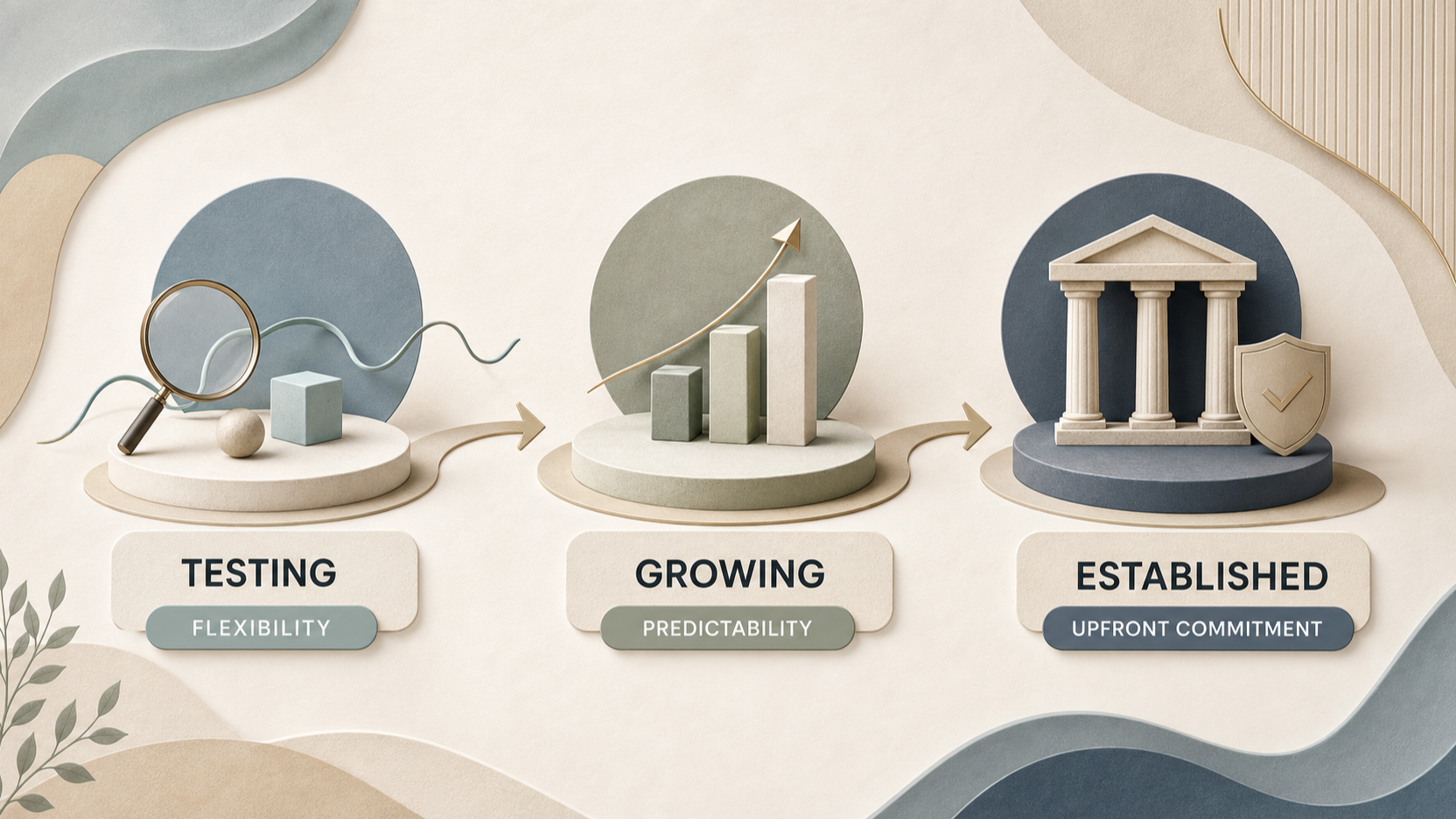 A business stage is a useful lens because it focuses the decision on uncertainty rather than on a generic preference for yearly or monthly billing.
Testing or launching. Monthly billing may be easier to justify when you are validating product demand, learning which channels work, or still deciding whether the platform’s workflows fit the team. Prioritise the minimum plan that supports a credible launch, then revisit once sales and operational needs are clearer.
Growing. Compare the expected next-stage requirements with the plan table before choosing a longer term. A growing store may need additional staff access, stronger selling tools, more regional capability or different payment arrangements. Shopify’s UK plans, for example, list increasing staff allowances and distinguish regional-selling features at higher tiers; Squarespace’s table lists commerce and transaction-fee differences across tiers.[^shopify][^squarespace]
Established. Annual billing can be worth assessing where the store’s platform choice, plan tier and feature needs have been stable for long enough to make the upfront commitment manageable. Confirm that the annual offer applies to the intended configuration and that planned changes will not make the selection obsolete.
In every stage, compare plan-level suitability first and cadence second. The right question is not “Should every established store pay annually?” but “Does this term fit our current certainty, cash position and platform roadmap?” Start with our guide to starting an online store in the UK or scaling an ecommerce business, depending on where you are now.
Editorial decision-guide asset: testing, growing and established business stages balanced against flexibility, predictability and upfront commitment.
Frequently Asked Questions
Is an annual ecommerce plan always cheaper than paying monthly?
No. You need to compare the live annual and monthly prices for the same plan, region and configuration. Squarespace says annual payment can save up to 36%, but the amount and terms should be checked on its current pricing page. A lower subscription cost may still be outweighed by an unsuitable tier or a need for flexibility.[^squarespace]
Should a new online store start with a monthly plan?
It can be a sensible option when the business is still testing demand, workflows or platform fit, because it limits the length of the initial commitment. It is not a universal rule: compare the features needed for launch, the available cash and the current official terms before deciding.
Do transaction fees change when you choose annual billing?
Do not assume they do. Squarespace lists online-store and digital-content transaction fees by plan tier, while Shopify’s UK pricing page lists card rates by tier. Check the official page and your payment setup to understand which charges apply to the plan you are considering.[^squarespace][^shopify]
What should I check before switching from monthly to annual billing?
Confirm the exact plan tier, annual price and term, included features, payment-related charges, team and regional requirements, and the likelihood that you will need to change platform or plan during the commitment. Recheck the current official terms immediately before you switch. For more context, see our ecommerce platform pricing explainer.
[^squarespace]: Squarespace, Pricing. [^shopify]: Shopify, UK pricing.
Related reading
- Shopify review for UK merchants: strengths, limits, costs, and alternatives
- Squarespace Commerce review for UK creators and small online stores
- Ecommerce platform feature checklist: inventory, payments, shipping, and integrations
- How to compare ecommerce platform deals without overlooking transaction fees and add-ons
Editorial information: About our editorial team · Read our editorial policy · Read our affiliate disclosure.