Choosing an ecommerce platform is less about finding a universal winner and more about deciding whether a platform can support the way your team sells, operates and plans to grow. This guide looks at BigCommerce through that lens, using its published platform and pricing information to help UK retailers prepare a more useful shortlist, demo and plan discussion.
BigCommerce at a glance for UK growing retailers
BigCommerce is an ecommerce platform that presents tools and services across the journey of building, running and growing an online store. Its published platform range covers store design, apps and integrations, B2B commerce, selling channels, product feed management, multi-storefront operations, international commerce, data and analytics. It also lists operational areas including checkout, payments, inventory, shipping and promotions. BigCommerce’s platform overview provides the starting point for understanding that scope.
For a growing UK retailer, that breadth makes BigCommerce worth putting on a shortlist when the business is comparing more than a basic storefront. The relevant question is not whether every listed capability will be needed on day one. It is whether the capabilities that matter to your business can work together with your existing processes, people and technology.
This is therefore a platform-fit guide rather than a ranking. It focuses on the buying questions that help a retailer move from an initial impression to a practical evaluation: what needs centralising, which integrations matter, how a migration would be handled, and what support may be needed to launch and operate the store.
For broader context, compare your requirements with an ecommerce platform comparison guide and a guide to choosing an ecommerce platform.
What BigCommerce is built to help retailers manage
BigCommerce publicly describes a platform intended to cover both the customer-facing store and several connected areas of commerce operations. Its store-building offering is presented as allowing teams to build with or without code. That distinction may be useful for retailers that need marketing or trading teams to make routine changes while also wanting technical flexibility for more specialised work.
The platform also lists apps and integrations, with BigCommerce stating that it offers more than 1,200 apps to help businesses grow. An app count alone does not establish that a specific retailer’s tools will connect in the right way, but it signals that integration discovery should be a core part of the evaluation. Identify the services your team already relies on—such as fulfilment, accounting, marketing, customer support or product information—and ask how each one would be connected, maintained and supported.
For selling activity, BigCommerce lists B2B Commerce, Channels & Advertising, Product Feed Management, Multi-Storefront, Composable Commerce and International Commerce among its areas of focus. These categories can be relevant where a retailer expects to sell through more than one route, serves trade customers as well as consumers, manages several storefronts, or needs product information to travel consistently to external channels. Their relevance will depend on your operating model, not on the presence of the label alone.
BigCommerce also identifies data and analytics alongside operational functions such as checkout, payments, inventory, shipping and promotions. A useful evaluation should map these areas to real ownership inside your business. For example, establish who will manage catalogue changes, resolve order exceptions, oversee promotions, check performance data and approve new integrations. That exercise often reveals whether the platform’s published scope is aligned with the way your team actually works.
Use an ecommerce store management guide and a multichannel selling guide to turn those broad categories into a requirements list for your team.
Questions to ask before choosing BigCommerce
A platform choice should be treated as a requirements-matching exercise. BigCommerce publishes information on platform capabilities, professional services, success services, training and plan information, but each retailer still needs to establish what applies to its own intended setup. BigCommerce’s pricing and plan information is a sensible place to begin a current plan conversation; confirm details directly with BigCommerce before treating any plan feature, service or commercial term as committed.
Start with scope. Which store, selling-channel and operations capabilities are necessary at launch, and which are later-stage possibilities? This prevents a team from paying attention to appealing categories that do not solve its priority problems. It also gives the retailer a clear way to compare BigCommerce with alternatives on the same requirements.
Then examine implementation. BigCommerce lists implementation project management, solution architecture, data migration and optimisation, and an enterprise launch package within its services information. Ask what support is available for your proposed plan and situation, who would carry out each activity, what information your team must prepare, and what launch milestones would be used. Published service categories should prompt specific questions, not assumptions about what is included.
Integration diligence is equally important. Make a list of essential systems, then ask whether each integration is available, what data is exchanged, who owns the setup, and what happens when an external system changes. If an app or custom connection is involved, clarify ongoing maintenance, costs and internal technical responsibility.
Finally, test operational fit. Ask how your proposed catalogue, checkout, fulfilment, promotions, customer service and reporting routines would work in practice. Bring representative examples rather than broad descriptions: a typical product, a complex order, a return, a promotion and a reporting question. A demo is most informative when it follows a realistic workflow.
For preparation, see an ecommerce platform pricing guide and an ecommerce platform migration checklist.
How to evaluate BigCommerce for your business
AI-generated generic editorial illustration — not a retailer product photo and does not depict the reviewed product or service. Give readers a practical visual framework for evaluating fit without making an unsupported recommendation.
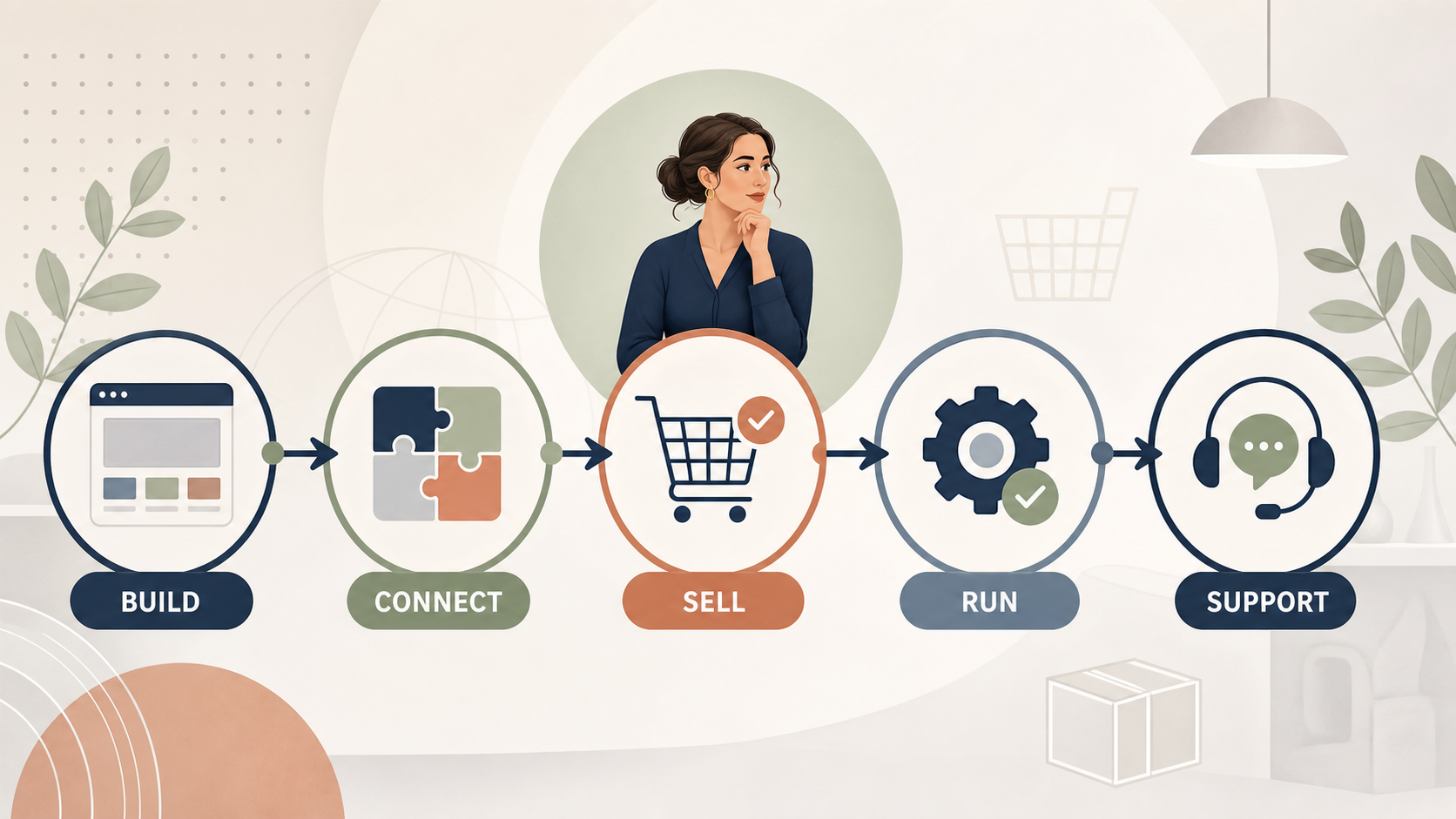
Use a structured evaluation to decide whether to progress to a demo, a detailed plan review or a comparison with other platforms.
1. Define the business case
Write down what the new or changed platform must enable over the next stage of growth. Separate non-negotiables from useful future options. Include the storefront experience, catalogue needs, customer types, sales channels, fulfilment process, reporting needs and the people who will operate the store. This gives the evaluation a decision standard that is specific to your business.
2. Map requirements to published platform areas
Compare your list with BigCommerce’s published areas: store design, apps and integrations, B2B commerce, channels and advertising, product feed management, multi-storefront, international commerce, data and analytics, plus checkout, payments, inventory, shipping and promotions. Mark each requirement as confirmed only after you have seen current, relevant information for your intended setup. Mark anything unclear for follow-up rather than assuming that a broad platform category answers the detail.
3. Check the implementation path
BigCommerce lists implementation project management, solution architecture, data migration and optimisation, training, customer success management and technical account management among its published services. Ask which of these are relevant and available for your proposed arrangement, and what your own team or partner would need to provide. If migration is part of the project, document the source data, integrations, testing approach and launch responsibilities before making a timetable.
4. Run a workflow-led demo
Bring a short set of real scenarios. Ask the demonstrator to show how a team would create or update a product, manage an order, handle a promotion, connect a required service and find the information needed for an operational decision. Keep a record of what was demonstrated, what was stated, and what still needs written confirmation. This makes it easier to compare BigCommerce fairly with other shortlisted platforms.
5. Review the plan and support position
Use the current pricing and plan information as the basis for a direct conversation with BigCommerce. Confirm the plan scope, relevant capabilities, implementation arrangements, training and support routes for your specific proposal. Do not rely on an old screenshot, another retailer’s setup or a general platform summary when a decision depends on current terms or availability.
6. Decide the next step
If the priority workflows, integrations, migration approach and support model are sufficiently clear, progress to a detailed commercial and implementation review. If material questions remain, request the missing information or compare the same requirements against other platforms. The goal is a defensible fit decision, not a quick verdict.
An ecommerce platform demo checklist and an online store growth planning guide can help your team prepare the right questions.
Frequently Asked Questions
Is BigCommerce suitable for a growing UK online retailer?
It may be suitable to evaluate if its published capabilities match the retailer’s operational requirements. BigCommerce lists store building, apps and integrations, selling-channel functions, business operations and services for implementation, migration, training and growth support. Suitability depends on the retailer’s required workflows, existing systems, internal skills and the current plan and support arrangement being considered. A UK team should use those requirements to guide a direct conversation and comparison rather than assume that a platform is right for every growing business.
What should I compare when reviewing BigCommerce plans?
Compare the current plan information against the capabilities and support your team actually requires. Cover store and operational requirements, necessary integrations, selling channels, migration needs, implementation responsibilities, training and ongoing support. BigCommerce publishes pricing and plan information, but a retailer should verify current scope and commercial details directly with BigCommerce before making a purchase decision. It is also useful to compare the same checklist with each alternative platform so that differences are meaningful.
Can a retailer migrate an existing store to BigCommerce?
BigCommerce publicly states that retailers can migrate from Shopify, WooCommerce, Salesforce, Magento and other platforms, and it lists data migration and optimisation as part of its published services information. That does not establish the work required for a particular store. Before committing, confirm the source data to be moved, the integrations that need replacement or reconnection, responsibilities, testing steps and the proposed launch approach. A platform migration guide can help structure that discussion.
What should a team ask in a BigCommerce demo?
Ask the demo to follow your real operating scenarios rather than a generic tour. Include product updates, order handling, promotions, the required integrations, reporting and any relevant sales-channel or customer-type workflows. Ask what is shown in the proposed plan, what depends on an app, partner or custom work, and what your team would need to manage after launch. Record unanswered questions and seek current written clarification where they affect the buying decision.
For further plan context, see BigCommerce pricing explained.
Related reading
- Best ecommerce platforms for UK small businesses: evidence-led choices by store need
- Squarespace Commerce review for UK creators and small online stores
- How to choose an ecommerce platform for a UK small business
- How to compare ecommerce platform deals without overlooking transaction fees and add-ons
Editorial information: About our editorial team · Read our editorial policy · Read our affiliate disclosure.